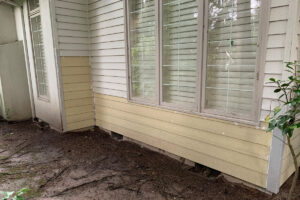
Siding failure is one of the most expensive problems a homeowner can overlook, because it never looks like an emergency until it already is one. It begins as a small crack or a slightly warped panel and silently lets moisture into the wall cavity, rots the framing, and feeds mold growth behind walls you cannot see. The damage compounds every single season, and by the time it shows up indoors, the repair scope has already grown far beyond what it needed to be. Each week of delay is a week of continued wetness in the wall cavity, compromised insulation, and deeper rot in the framing. If you are already asking should I remodel or move, the condition of your siding may be the deciding factor, and the team at Tracy’s Quality Painting has been helping homeowners make that call with confidence since 1982.
This blog walks you through 7 specific signs your siding is failing, what each one means structurally, and what happens if you ignore it.
Cracks and Holes in Your Siding
Why Even a Hairline Crack Is Serious
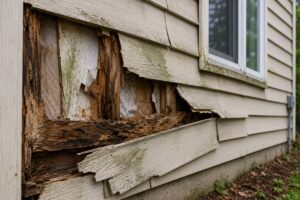
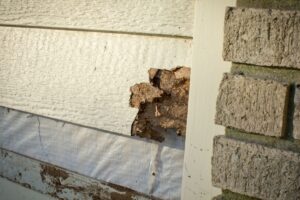
A crack in siding is not just a surface defect. It is a direct entry point for liquid water, water vapor, and insects into the wall assembly. Most homeowners don’t realize that siding isn’t just water-resistant, it’s water managed. Most modern siding systems use a drainage plane: a layer behind the panels that directs any water that gets past the siding back out. That drainage plane is entirely avoided when cracks develop.
Water that enters through a crack does not drain; it absorbs. The wood framing, sheathing, and insulation act like a sponge. Mold can begin to grow in a wall cavity if moisture is present for a period of 24 to 48 hours. You don’t see it. You can’t smell it yet. But it’s there.
Fiber cement and engineered wood sidings, like James Hardie (Hardie Plank) and LP siding, resist cracking far longer than older wood or vinyl products. But no material is indefinite. Our team at Tracy’s Quality Painting has completed over 95 siding projects across Gig Harbor, WA, Tacoma, and University Place, WA, and cracked panels are one of the most consistent entry points for the dry rot damage we find underneath.
Warped or Buckling Siding Panels
Panels that bow outward or ripple along the wall are not an installation quirk; they are a structural symptom. Warping usually indicates that moisture has been trapped behind the panel for a long time. The moisture in the panel is trapped and goes through wet and dry phases, which causes it to expand and contract and ultimately deform permanently.
What makes this dangerous is the gap it creates. A buckled panel no longer seals against the adjacent panels or the trim. Wind-driven rain, common in Fox Island, WA, and Port Orchard, WA, gets pushed directly into those gaps, bypassing the drainage plane entirely.
A buckled panel is not a cosmetic issue. It is a broken seal on your home’s envelope, and your wall cavity is absorbing the consequences right now.
Mold, Mildew, or Fungus Growth
1. Surface Mold vs. Cavity Mold: Know the Difference
Surface mildew on painted siding is manageable. A pressure wash and a fresh coat of exterior paint can address it. But if you see mold or dark fungal growth pushing through the seams between panels, starting at the bottom of the siding, or spreading in clusters near trim and window edges, that growth is coming from moisture that’s trapped inside the wall, not the outside surface.
This distinction matters enormously. Interior cavity mold cannot be solved with paint or surface cleaning. It requires removing the siding, treating the underlying structure, replacing any compromised sheathing or framing, and then re-siding. For homeowners weighing the pros and cons of remodeling their home versus moving, discovering cavity mold changes the calculus significantly, but it almost never makes moving the smarter choice. It makes early action the smarter choice.
2. Peeling Paint or Faded Exterior Walls
Paint on siding does not peel from the outside in. It peels from the inside out. Moisture vapor pushing outward through the wall breaks the bond between paint and substrate, causing it to bubble and flake. If you are painting the same parts of your exterior every two to three years, the problem is not the paint, but what the paint is sitting on.
Fading is another story, but equally telling. This is aging the siding, but it can no longer hold a finish properly on the surface. When our estimators analyze a home’s exterior in Steilacoom, WA, or University Place, WA, persistent paint failure is one of the clearest indicators that the underlying material has reached the end of its serviceable life.
3. Rising Energy Bills Inside the Home
This is the sign homeowners most often attribute to the wrong cause. If your heating or cooling bills have increased substantially without a change in your consumption habits, failing siding is a legitimate suspect.
Siding is a key component of your home’s thermal envelope. Gaps, cracks, and deformed panels can allow conditioned air to escape and outdoor air to infiltrate. This is called thermal bridging. Your HVAC system compensates for longer run times. The loss of efficiency is real and measurable.
In the remodel vs move which is better conversation, energy performance is often overlooked. A full siding replacement can be a great way to increase a home’s energy efficiency when done right with the proper insulation and air sealing. That improvement pays off over time in lower bills and higher resale value.
Most homeowners spend years paying for damaged siding through their energy bills without ever realizing the connection.
4. Water Stains or Moisture Damage Indoors
Interior wall staining near exterior surfaces is the point where siding failure stops being invisible. By the time water is staining your drywall, it has already traveled through the siding, through the weather-resistant barrier, through the insulation, and into the interior wall assembly. That is a complete failure of the exterior envelope.
The framing behind those stains is almost certainly compromised. Wet wood framing gradually loses structural integrity; it does not fail all at once. But over time, it cannot support the loads it was designed to carry. For homeowners in Gig Harbor, WA, who are wondering about the cost to remodel vs buying a new home, this is the stage where acting quickly keeps the scope and the investment manageable.
Our TQP Home Services division handles both siding replacement and dry rot repair and investigation, so we assess the full extent of structural damage in a single visit.
Frequent Need for Repairs and Maintenance
5. When Maintenance Costs Are Telling You to Stop Maintaining
There is a point at which repetitive repairs stop being maintenance and start being a financial drain with no return. Painting the same section every two years, caulking the same seams every fall, patching the same corners after every winter, these are the patterns that show the material has failed, not just one isolated spot.
This is exactly how to decide between remodeling and moving, or more precisely, how to decide between replacing the siding and replacing the house. A targeted siding replacement delivers a permanent solution, measurable energy improvements, and a significant boost to curb appeal and resale value. The moving vs home improvement decision rarely favors moving when the underlying issue is a correctable cladding failure.
Tracy’s Quality Painting works with LP siding, James Hardie siding, cedar, board and batten, and shakes, matching the right material to each home’s exposure, climate conditions, and architectural style. Every project is built to code by carpenters who treat it as a permanent solution, not a patch.
Your Siding Has Been Sending Warnings, Here’s What to Do Next
Every sign on this list, from hairline cracks to interior water stains, follows the same course: a small, invisible problem that becomes an expensive one. The Pacific Northwest climate accelerates that timeline. Rain, humidity, and temperature swings hit siding harder here than in most of the country, and homes in Gig Harbor, WA, Fox Island, WA, Port Orchard, WA, Steilacoom, WA, and University Place, WA feel it every season.
For homeowners thinking through the pros and cons of moving to a new house versus investing in their current home, the answer, in almost every case, is to fix the problem. Is it cheaper to renovate or move? When the issue is failing siding, renovation wins. When done right, a new siding is one of the best investments a homeowner can make because it returns the most money, and it removes the moisture, energy, and structural risks that lead to repair costs year after year. Home renovation vs selling your house becomes an easy decision when the fix is both targeted and lasting.
At Tracy’s Quality Painting, we have handled siding repair, siding replacement, dry rot repair, and full exterior restoration across the greater Gig Harbor area since 1982. Our carpenters are trained in proper building techniques and local codes. Our estimators analyze your home’s actual exposure and environmental conditions, not just what’s visible on the surface. We offer a 100% satisfaction guarantee, and we will not stop until the work is done right. If your siding has been showing any of these signs, call us today for a no-obligation quote at (253) 858-8242. The longer you wait, the more damage to your home, the damage claims, and that is a cost no homeowner should have to absorb.