Siding doesn’t collapse overnight; it surrenders inch by inch, panel by panel, in ways most people walk past every single day without noticing. A hairline crack lets in the first drop. A slightly bowed panel breaks the seal. A dark streak near a seam gets written off as dirt. And the entire time, water is working its way behind the wall, rot is taking hold of the framing, and what could have been a straightforward repair is quietly becoming a structural overhaul. The Pacific Northwest climate, constant rain, temperature swings, salt air near the water, doesn’t cut siding any slack, and it doesn’t wait for you to notice.
The signs your siding needs repair are almost always visible long before the damage becomes catastrophic. The problem is knowing what you’re actually looking at. At Tracy’s Quality Painting, we’ve completed over 95 siding projects across the region, and what we see most often is damage that could have been caught and stopped much earlier.
This blog walks you through the real siding damage warning signs every homeowner should know: what to look for, what those signs actually mean, and what happens to your home and your wallet if you ignore them.
Common Signs Your Home Siding Needs Repair
- The Ones Most Homeowners Miss
The obvious signs: cracks, holes, and missing panels, most people catch. It’s the subtle ones that cause the most damage. Soft spots when you press a panel, a slight bowing that is only visible from an angle, paint that bubbles in one small part of an otherwise fine wall. These are the signs your siding needs repair that don’t announce themselves. They wait. By the time they’re undeniable, water has already been sitting behind the wall.
Here are the warning signs worth taking seriously:
| Warning Sign | What It Signals |
| Soft or spongy panels | Active rot or trapped moisture behind the wall |
| Paint bubbling in one area | Water vapor pushing outward from inside |
| Panels slightly bowed or uneven | Moisture expansion and material breakdown |
| Dark streaks near seams | Mold tracking along a water path |
| Drafts near exterior walls | Gaps in the thermal barrier from failing siding |
Every month you wait, the damage isn’t standing still; it’s spreading.
Cracks, Holes, and Warped Siding Panels to Watch For
A hairline crack in your siding isn’t cosmetic. It’s an entry point. Water doesn’t need more than a millimeter of space to get behind a panel, and once it’s in, it has nowhere to escape.
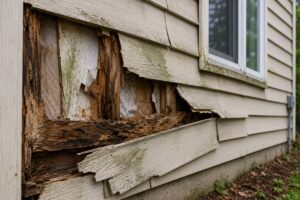
Warped or buckling siding panels are one of the clearest indicators that moisture has already infiltrated. When material absorbs water repeatedly, it expands and contracts. It loses dimensional stability over time, panels gap at the seams, pull away from the wall, or bow outward. At that stage, the siding is not functioning at all as a weather barrier.
What Type of Crack Actually Tells You
Not all cracks carry the same weight. Hairline surface cracks on older painted siding may simply mean the paint has aged. But deep cracks running the length of a panel, or cracks around fastener points, mean the panel itself is compromised. If you’re pressing on a panel near a crack and it feels soft or gives slightly, that’s rot, and it means water damage behind the siding has already begun.
How Moisture and Mold Can Damage Your Siding
Here’s what most homeowners don’t know: the EPA reports that mold can begin growing on a wet surface within 24 to 48 hours. Your siding doesn’t need to be soaked for days. A single storm that drives water into a panel gap is enough to start the process, and from there, mold and mildew on siding spread along moisture pathways faster than any surface treatment can stop.
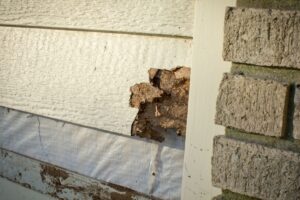
Mold and mildew on siding aren’t just a surface problem. Once mold establishes itself in the gap between your siding and your wall sheathing, it starts to work on the wood structure itself. What begins as a stained panel turns to rotted framing. The health implications for anyone inside the home are real, and the structural implications are expensive.
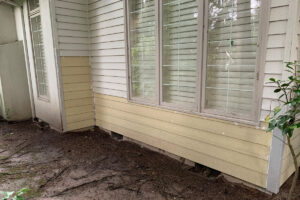
Watch for dark streaking that follows panel seams downward, or patches of green or black growth near the base of the siding where water pools longest. These aren’t aesthetic issues. They’re structural ones.
Why Peeling Paint and Fading Siding Matter
Peeling paint on house siding is one of the most commonly dismissed warning signs there is. It’s easy to assume the paint just needs a refresh. Sometimes that’s true. But if paint peels in patches, bubbles up from underneath, or cracks within a couple of years after it’s applied, it’s almost always because moisture is trying to escape from behind the siding. The paint isn’t the problem; it’s the messenger.
Fading matters for a different reason. UV degradation breaks down the surface layer of siding material, making it more porous and more vulnerable to moisture penetration. Uneven fading, one section much more faded than the adjacent panels, often indicates that the section has lost its protective integrity and is absorbing more than it should.
Your siding is the only thing standing between the Pacific Northwest rain and your home’s structural frame. Treat it accordingly.
Checking for Loose or Missing Siding After Storms
The Pacific Northwest doesn’t issue warnings before it goes hard. High winds, driving rain, and debris impacts happen fast, and they cause damage that is not always obvious from the ground.
After any significant storm, walk the perimeter of your home and look at the siding at eye level, not just the sections you can easily see. Begin by checking corner pieces and J-channels, since those are the weakest points. A fastener for a panel, seemingly distant, can be broken, causing the panel to flex in the following wind event, resulting in a gap large enough for water to freely enter.
When to repair home siding after a storm is simple: immediately upon finding damage. Even a 48-hour delay in a wet weather window allows moisture to begin working behind the wall.
How Damaged Siding Can Increase Energy Bills
Failing siding and rising utility bills are directly connected, and most homeowners don’t make that connection until a contractor points it out. The U.S. Department of Energy attributes 25–40% of heating and cooling energy loss in many homes to air leaks through the building envelope. Warped, cracked, or separated siding panels are a direct contributor to that.
When your siding stops sitting flush against the wall, it creates unplanned ventilation. Your HVAC system compensates. You pay for that compensation every month, in every season. This is one of the clearest ways how to tell if siding is failing before any visible rot or mold appears.
When to Call a Professional for Siding Inspection
Repair or Replace: How to Actually Decide
This is the question we hear most: siding repair vs replacement, which one do you actually need? The honest answer is, it depends on how much damage there is, what kind of material it is, and how long the problem has existed.
A professional siding inspection for homeowners goes well beyond surface observation. Experienced contractors will look for soft spots, test for moisture in the wall cavity, and determine how much of the structure behind the siding has been compromised. When damage is isolated to one or two panels and the surrounding structure is sound, repair is the right move. Replacement is the smarter investment when multiple panels are affected, when rot has penetrated the sheathing, or when the siding material itself is at the end of its life.
Trying to determine this yourself, without the right tools or experience, often results in one of two outcomes: you replace siding that could have been repaired, or you repair siding that needed full replacement and face the same problem again in two years.
Don’t Let the Rain Win: What Every Homeowner Needs to Take Away
Siding damage follows a predictable pattern: small and ignorable, then sudden and expensive. The siding damage warning signs outlined in this blog, warped or buckling siding panels, mold and mildew on siding, peeling paint on house siding, loose panels after storms, and rising energy bills, rarely appear all at once. They build on each other, quietly, until the repair conversation becomes a replacement conversation. Knowing how to tell if siding is failing early is the only way to stay ahead of that curve.
At Tracy’s Quality Painting, our team has been handling siding repair vs replacement across Gig Harbor, WA, Fox Island, WA, Port Orchard, WA, Steilacoom, WA, and University Place, WA since 1982. We work with LP siding, James Hardie plank, Cedar, Board & Batten, Shakes, and more. Our carpenters are trained in proper building codes and techniques, and our goal is always a permanent solution, not a temporary fix. A proper siding inspection for homeowners with us means you’ll know exactly where you stand, what needs to be done, and what it will take to protect your home correctly.
If you’ve noticed any of the signs your siding needs repair mentioned in this blog, don’t wait for the next storm to make the decision for you. Call Tracy’s Quality Painting today at (253) 858-8242 for a free, no-obligation assessment. We’ll take an honest look, give you a straight answer, and help you protect what matters most.